SHARED CARE
How to share pet care without the repeated questions
Set up a shared pet care routine with clear tasks, a completion record and a simple plan for changes and offline handovers.
“Did you feed the dog?” is usually a question about the record, not a lack of care. When several people look after the same pet, each person knows only what they did or heard about. A shared routine gives everyone somewhere to look.
Start with the tasks people need to see
Write down meals, walks and recurring care you already do. Give each task a name that means the same thing to everyone. If “evening routine” includes several jobs, decide whether those jobs should be recorded separately.
A daily task and a one-off appointment have different roles: one keeps the routine moving, the other needs attention on a particular day. Kodu’s Planner supports recurring tasks and tasks on specific dates.
Agree who usually does what
A shared list does not assign responsibility by itself. Talk about who normally handles each part of the day and who is the backup. Put details the other person needs into the task note. Do not assume they know your usual shorthand.
For prescribed treatment, keep the veterinarian’s directions accessible. The shared list records the care; it does not replace professional instructions.
Record completion when it happens
The person who does a task should mark it complete. Waiting until the end of the day leaves a gap in which someone else may repeat it. If you are not sure whether a task was done, ask instead of marking it based on an assumption.
Set up a Care Circle in Kodu
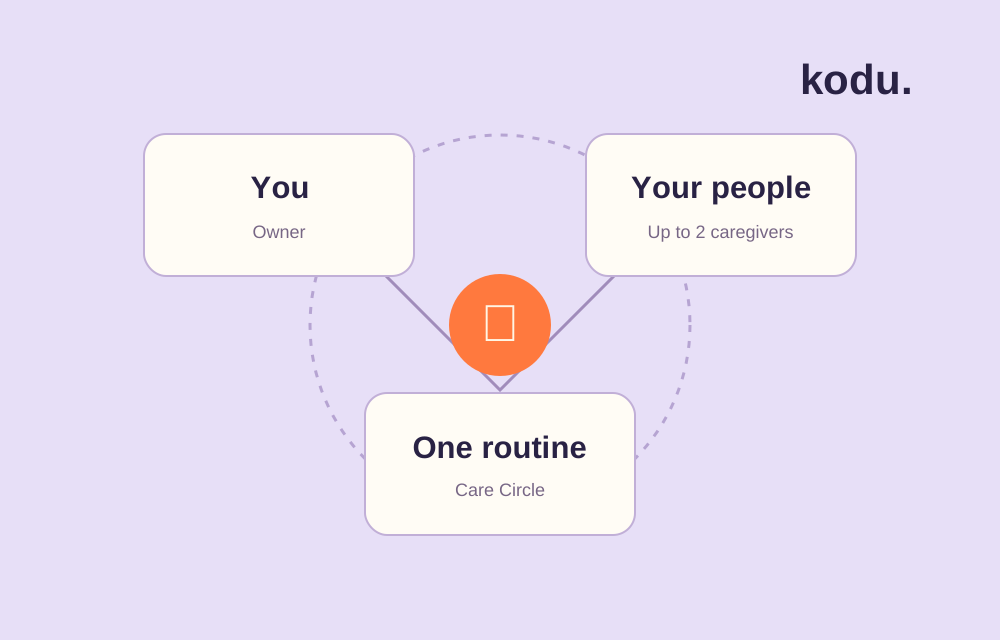
The owner needs active Kodu Pro to create a Care Circle and invite caregivers. A circle has one owner and up to two invited caregivers. Invited caregivers do not need a second Pro purchase to take part in that circle.
Once a caregiver joins, they work with the owner’s shared records and tasks. Only the owner manages invitations. Use invitations for people you trust, and do not post codes in public.
Have a plan for changes
If someone is late or a task needs a different time, update the plan and tell the next person. Shared records need a connection to travel between devices. An offline phone may still show an earlier state, and a notification is not proof that someone has read an update.
A good handover can be one sentence: what you did, what changed and what the next person needs to do. Keep urgent details in a direct conversation.
Review the routine together
After a few days, remove tasks that add noise and clarify the ones that cause questions. The aim is a record you trust, not the longest possible checklist.
For temporary help, use the pet sitter handover checklist. For plan limits, see Kodu Pro.